
Share the article on your social media and chat and help other travelers like you:


Catania is a city with unique charm, where every corner tells centuries of history and artistic traditions. Walking through the historic centre, declared a World Heritage Site by UNESCO, you will immerse yourself in a cultural heritage that ranges from the Greco-Roman to the Sicilian Baroque. Impressive monuments, frescoed churches and ancient palaces testify to the artistic evolution of the city, offering visitors a fascinating path between past and present.
For those staying in an apartment in the heart of Catania, exploring its historical wonders becomes an authentic and engaging experience. In this itinerary, we will discover seven places that tell art and history in Catania, guiding visitors to discover its rich cultural heritage.
- 1. Piazza del Duomo, Fountain of Elephant and the Cathedral of Sant'Agata
- 2. Teatro Romano and Odeon
- 3. Via dei Crociferi: The Heart of Catalan Baroque
- 4. Ursino Castle: Witness to Medieval History
- 5. Benedictine Monastery of San Nicolò the Arena
- 6. Palazzo Biscari: Example of Baroque Elegance
- 7. Museo Civico Belliniano: Tribute to the Composer Vincenzo Bellini
- A Stay between Art and History in Catania
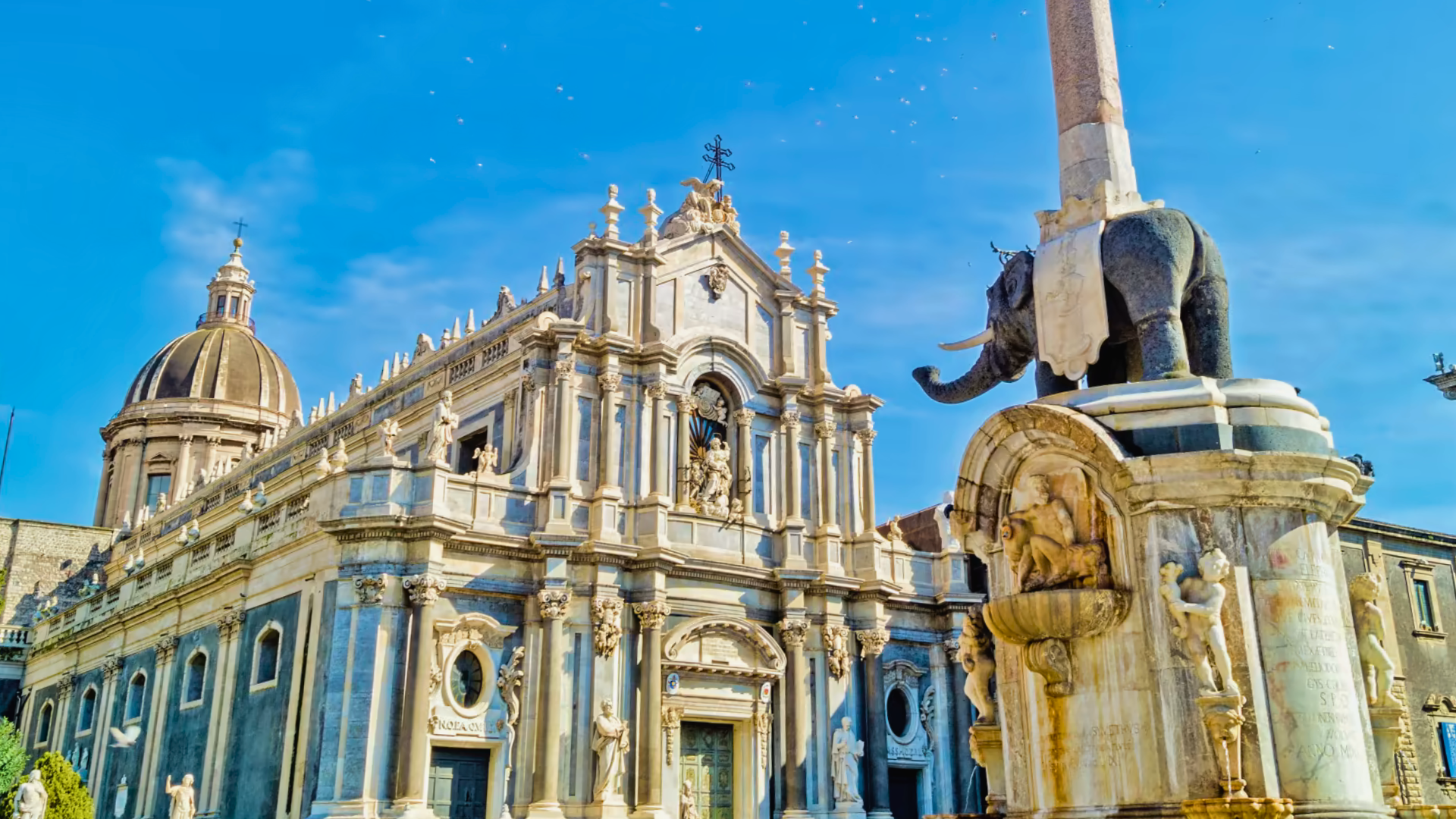
1. Piazza del Duomo, Fountain of the Elephant and the Cathedral of Sant’Agata
Piazza del Duomo represents the beating heart of Catania, a place where art and history intertwine harmoniously, offering visitors an authentic insight into the cultural heritage of the city. Located at the intersection of the main city arteries – via Etnea, via Giuseppe Garibaldi and via Vittorio Emanuele II – the square is surrounded by buildings and monuments of great historical and artistic importance.
In the centre of the square stands the Elephant Fountain, affectionately called "u Liotru" by the Catalans. This lava stone sculpture depicting an elephant supporting an obelisk was made between 1735 and 1737 by the architect Giovanni Battista Vaccarini. The elephant, a symbol of strength and protection, has become the emblem of the city, and its origin is shrouded in local legends that enhance its charm.
Dominating the eastern side of the square is the majestic Cathedral of Sant’Agata, dedicated to the patron saint of Catania. Built on the ruins of ancient Roman baths, the cathedral has undergone several reconstructions due to earthquakes that have hit the city over the centuries. Inside are kept the relics of Saint Agatha, the object of deep veneration by the faithful, especially during the annual celebrations in his honour.
Piazza del Duomo, with its unique combination of Baroque architecture, symbolic monuments and deep religious roots, perfectly embodies the essence of art and history in Catania, offering visitors an unforgettable experience in the heart of the city.
2. Teatro Romano and Odeon
The Teatro Romano and theOdeon of Catania represent significant evidence of art and history in Catania. Located in the heart of the historic centre, between Via Teatro Greco and Via Vittorio Emanuele II, these buildings offer a fascinating insight into the cultural life of the ancient city.
The Roman Theatre, dating back to the 2nd century AD, was built on the southern slopes of the hill of Montevergine, the ancient acropolis town. With a diameter of about 80 meters, it could accommodate up to 7,000 spectators. The orchestra, the cavea and some remains of the scene are still visible today.
Adjacent to the theatre is the Odeon, a smaller semicircular structure, also dating back to the second century AD. With a capacity of about 1,500 spectators, the Odeon was intended for musical and dance performances, as well as serving as a venue for rehearsals of nearby theatre shows.
These two buildings, built mainly of lava stone, represent significant examples of Roman architecture and are precious evidence of art and history in Catania. Visiting them, you can immerse yourself in the atmosphere of the ancient city and understand the importance of culture and entertainment in the everyday life of the time.

3. Via dei Crociferi: The Heart of Catalan Baroque
Via dei Crociferi is one of the most emblematic streets of Catania, representing a shining example of the Sicilian Baroque. Situated in the heart of the historic center, this street stretches for about 410 meters, offering visitors an uninterrupted sequence of religious and monumental buildings of extraordinary beauty. To travel through Via dei Crociferi means to immerse yourself in the art and history of Catania, admiring architectural masterpieces that testify to the artistic fervor of the 18th century.
Access to the route takes place under the Arch of San Benedetto, a structure built in 1704 that connects two parts of the Benedictine Monastery. According to tradition, this arch was erected in one night, symbolizing the union between the two sections of the convent.
Continuing along the road, you will encounter several churches of considerable importance:
- Church of San Benedetto: known for its staircase and the wrought iron gate, it represents a significant example of the Baroque architecture of Catania.
- Church of San Francesco Borgia: characterized by two staircases, stands next to the Jesuit College, a building with an internal cloister adorned with porticos on columns and arches.
- Church of San Giuliano: considered one of the best examples of Catalan Baroque, it has a convex facade attributed to the architect Giovan Battista Vaccarini.
In addition to its artistic significance, Via dei Crociferi is shrouded in folk legends. One of the best known is that of the "headless horse": It is said that in the 18th century, the route was frequented by individuals who wanted to keep anonymity. To discourage the curious, the rumour spread that, after sunset, a horse without head wandered the street, fueling fears and superstitions among citizens.
Visiting Via dei Crociferi offers a unique experience to understand the art and history of Catania, allowing you to appreciate the majesty of Sicilian Baroque and to immerse yourself in the traditions and stories that shaped the identity of the city.

4. Ursino Castle: Witness to Medieval History
The Ursino Castle is one of the most representative symbols of art and history in Catania. Built in the 13th century by Emperor Frederick II of Swabia, the manor was to strengthen the defensive system of eastern Sicily and serve as an imperial residence. The design was entrusted to the architect Riccardo da Lentini, who chose a strategic promontory for its construction.
Over the centuries, the castle has played fundamental roles in Sicilian history. During the Sicilian Vespers, he hosted the Parliament which in 1295 declared James II fallen and elected Frederick III as king of Sicily. Later, it became royal residence for several Aragonese rulers, including Frederick III and his descendants. In addition to its historical significance, the Ursino Castle is surrounded by fascinating legends. According to popular tradition, before the arrival of humans, the fortress was inhabited by the Ursini giants, mythological creatures defeated by the paladin Uzeta, a hero celebrated in the works of the Catalan puppets.
Today, the castle houses the Civic Museum of Catania, where there are art collections and archaeological finds that testify to the rich cultural heritage of the city. The visit to the Ursino Castle offers a deep immersion in art and history in Catania, allowing visitors to relive the medieval events and traditions that shaped the Catania identity.

5. Monastery of the Benedictines of San Nicolò the Arena
The Benedictine Monastery of San Nicolò l’Arena, is one of the most imposing monastic complexes in Europe and represents a shining example of art and history in Catania. Located in the heart of the city, this monument tells centuries of historical events and architectural transformations.
Founded in 1558 by the Cassinese monks, the monastery suffered numerous natural disasters, including earthquakes and volcanic eruptions, which resulted in destruction and subsequent reconstructions. These vicissitudes have helped to create a unique architecture, the result of the integration of different historical periods.
Today, the Monastery houses the Department of Humanities of the University of Catania, serving as a bridge between the past and the present. Its structure includes elements of different eras, including archaeological remains and monumental installations, harmonised by the work of architects of the past.
Visiting the Benedictine Monastery offers a deep immersion in art and history in Catania, allowing you to appreciate the cultural and architectural stratification that characterizes the city.

6. Palazzo Biscari: Example of Baroque Elegance
Palazzo Biscari is the most sumptuous private building in Catania, representing an emblematic example of art and history in Catania. Its construction began at the end of the 17th century, after the devastating earthquake of 1693, at the behest of the Paternò Castello family, princes of Biscari. The palace was built on the sixteenth-century walls of Charles V, thanks to a special permit granted by Lieutenant General Giuseppe Lanza, responsible for the reconstruction of the city.
The architecture of the palace is a triumph of the Sicilian Baroque. The exterior facade is adorned with allegorical groups representing abundance, prosperity, fertility and wisdom. Inside, it is accessed through a large portal leading to a central courtyard, embellished by a majestic ladder. Among the main rooms stands the Salone delle Feste, in Rococo style, decorated with mirrors, stuccoes and frescoes by artists such as Matteo Desiderato and Sebastiano Lo Monaco. The hall is surmounted by a frescoed dome depicting the Glory of the Paternò Castello di Biscari family, used once to host the orchestra during the festivities.
One of the most fascinating stories related to the palace is the visit of Johann Wolfgang Goethe. During his trip to Italy, on 3 May 1787, the German writer was welcomed by the Prince of Biscari. Goethe was deeply impressed by the magnificence of the palace and the art collection inside, so much so as to mention it in his famous "Travel to Italy".
Today, Palazzo Biscari continues to be a symbol of Baroque elegance and art and history in Catania. Its frescoed rooms, rich in charm and elegance, are used for cultural events, concerts, meetings and receptions, keeping alive the tradition of meeting and culture.

7. Museo Civico Belliniano: Tribute to the Composer Vincenzo Bellini
The Museo Civico Belliniano, located in the eighteenth century Palazzo Gravina Cruyllas in Piazza San Francesco d’Assisi n. 3, is a place of great importance for those who want to deepen art and history in Catania. This historic building is known to be the birthplace of the famous composer Vincenzo Bellini, born here on the night between 2 and 3 November 1801.
The museum is spread across five rooms, each offering a detailed overview of Bellini’s life and work. Among the memorabilia on display, you can admire original manuscripts, musical instruments belonging to the composer's family, portraits, autograph letters and personal objects. Of particular interest is the death mask of Bellini, which offers a touching memory of his premature disappearance.
One of the most suggestive rooms houses the "Apotheosis of Bellini" by Michele Rapisardi, a work that celebrates the genius of the composer from Catania. In addition, scenic models represent the ten works composed by Bellini, allowing visitors to immerse themselves in the theatrical context of the time.
The museum not only preserves and enhances the heritage linked to Bellini, but also represents a point of reference for music enthusiasts and for those who want to understand more deeply the art and history in Catania. The visit offers a unique opportunity to explore the environment in which the "Cigno di Catania" took its first steps in the world of music, laying the foundations for a career that would leave an indelible imprint on the international opera scene.

A Stay between Art and History in Catania
To fully experience art and history in Catania, it is essential to stay in the beating heart of the city. Our apartments, located in the historic center, offer the perfect combination of modern comfort and historic atmosphere.
Why choose our apartments in the historic center of Catania?
- Living as a Local: Staying in the historic center allows you to breathe the authentic atmosphere of Catania, with local markets, typical restaurants and cultural events at your fingertips.
- Strategic Position: Located a few steps from the main monuments and cultural attractions, our accommodation allows you to immerse yourself in art and history in Catania without the need for long trips.
- Comfort and Style: Each apartment is tastefully furnished, offering comfortable and equipped with all the necessary services for a pleasant stay.
📌 Do you also want to discover the best restaurants and tourist attractions of Taormina and Catania? Read our article dedicated to where to eat and what to see in Catania and Taormina, with tips on the best places and the most iconic experiences in the area!
Book Now your stay in Catania
Share the article on your social media and chat and help other travelers like you: